


In Helicobacter pylori eradication therapy, acid-suppressing drugs are an important component of quadruple therapy. Recently, the results of an investigator-initiated (IIT) prospective, multicenter, randomized controlled study of an anaprazole sodium-containing regimen were officially published in Frontiers in Cellular and Infection Microbiology, adding new clinical evidence for anaprazole, a new-generation proton pump inhibitor independently developed by Xuanzhu Biopharma.
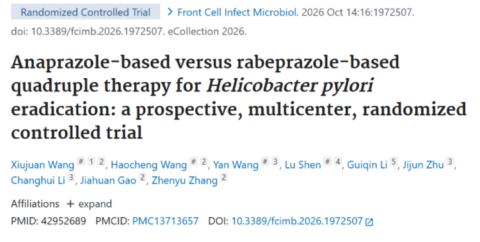
This study (Chinese Clinical Trial Registry No.: ChiCTR2600117235) was initiated by Professor Zhang Zhenyu of Nanjing First Hospital and conducted at 4 hospitals in Jiangsu Province. A total of 320 patients with Helicobacter pylori infection who had not previously received eradication treatment were enrolled and randomly divided into an anaprazole sodium 20 mg group and a rabeprazole sodium 20 mg group, with 160 patients in each group. Both groups were combined with amoxicillin, furazolidone, and colloidal bismuth pectin for 14 days of treatment; apart from the different PPI used, all other medications were identical. Four weeks after the end of treatment, eradication efficacy was assessed by the urea breath test.
Core Result: PP Analysis Eradication Rate Reached 90.9%
The study used intention-to-treat analysis (ITT), modified intention-to-treat analysis (mITT), and per-protocol analysis (PP) to evaluate eradication efficacy, and there were no statistically significant differences between groups in any of the three analyses. In the PP population that completed follow-up with good medication adherence, the eradication rate was 90.9% (130/143) in the anaprazole sodium group and 90.0% (126/140) in the rabeprazole sodium group. The PP eradication rates of both regimens exceeded 90%, with no statistically significant difference between groups (P = 0.80).
The overall incidence of adverse events was 22.50% in the anaprazole sodium group and 15.00% in the rabeprazole sodium group, with no statistically significant difference (P = 0.09). All reported adverse events were mild to moderate, and no serious adverse events were reported. The proportions with good medication adherence in the two groups were 89.38% and 87.50%, respectively, also with no significant difference (P = 0.60).
The regimen selection in this study fully took into account regional resistance characteristics. Surveillance data from the Nanjing area from 2018 to 2024 showed that the primary resistance rates of Helicobacter pylori to clarithromycin and levofloxacin were 50.01% and 38.59%, respectively, while the resistance rates to amoxicillin and furazolidone were 0.51% and 0.19%, respectively. Based on this resistance background and relevant guideline recommendations, the study adopted an antibacterial combination of amoxicillin plus furazolidone, providing a reference for research on eradication regimens in high-resistance areas.
Evidence-Based, Letting Innovation Respond to Clinical Needs
The value of an innovative drug lies not only in the publication of a research result, but also in continuously undergoing clinical testing and continuously responding to unmet clinical needs. This investigator-initiated clinical study has enriched the evidence-based evidence for anaprazole sodium in the field of Helicobacter pylori eradication treatment, and also provided a reference for exploring eradication regimens more aligned with Chinese clinical needs. Looking ahead, Xuanzhu Biopharma will rely on the ongoing Phase III study of anaprazole sodium for Helicobacter pylori eradication to continue advancing high-quality clinical research and academic exchange, further improving the evidence chain for efficacy and safety, promoting the translation of innovative achievements with a rigorous scientific attitude, and contributing more Chinese evidence to optimizing Helicobacter pylori eradication treatment strategies.
Literature Sources
Wang H, Li C, Peng R, Wang X, Gao J, Zhang Z. Phenotypic and genotypic analysis of Helicobacter pylori resistance patterns, molecular characteristics, and CYP2C19 polymorphisms in Nanjing: a retrospective cross-sectional study. Frontiers in Cellular and Infection Microbiology. 2026;16:1852534.
Wang X, Wang H, Wang Y, et al. Anaprazole-based versus rabeprazole-based quadruple therapy for Helicobacter pylori eradication: a prospective, multicenter, randomized controlled trial. Frontiers in Cellular and Infection Microbiology. 2026;16:1972507.
Statement:This article is only intended to convey academic research information and does not constitute diagnostic or treatment advice or medication recommendations. The indications, dosage, and safety information of drugs shall be subject to the instructions approved by the national drug regulatory authorities; for specific diagnosis and treatment, please follow the doctor's advice.
About Xuanzhu Biopharma
Xuanzhu Biopharma (Stock Code: 02575.HK) is an innovative pharmaceutical company rooted in China with a global vision, focusing on major disease areas such as digestion, oncology, and metabolism, and dedicated to the R&D, production, and commercialization of Class 1 new drugs with core independent intellectual property rights. As a research-driven, AI-empowered emerging commercial innovative drug company, the company has built a technology system that synergistically integrates a small-molecule drug R&D platform, a biologics R&D platform, a small nucleic acid R&D platform, and an AI drug R&D platform, thereby forming a product pipeline that is rare in China in simultaneously covering small-molecule chemical drugs, large-molecule biologics, small nucleic acid drugs, and other types. Guided by unmet clinical needs, the company is committed to becoming a first-class innovative drug enterprise with independent R&D, production, and sales capabilities.

9th Floor, North Tower of CP Center, No.20 Jin He East Avenue,Chaoyang District,Beijing,China
Tel:010-5765 4567
Email:XZGROUP@xuanzhubio.com
Copyright © 轩竹生物科技有限公司保留所有权利 冀ICP备2020028968号-2 网站建设技术支持:唯引互动
