


Acid-related disorders are prevalent gastrointestinal conditions worldwide. Although proton pump inhibitors (PPIs) have long served as the cornerstone of their treatment, conventional PPIs still face numerous challenges in clinical practice: slow onset of action, significant dietary dependence, and most notably, metabolic variations induced by CYP2C19 gene polymorphisms, which pose considerable difficulties for clinicians.
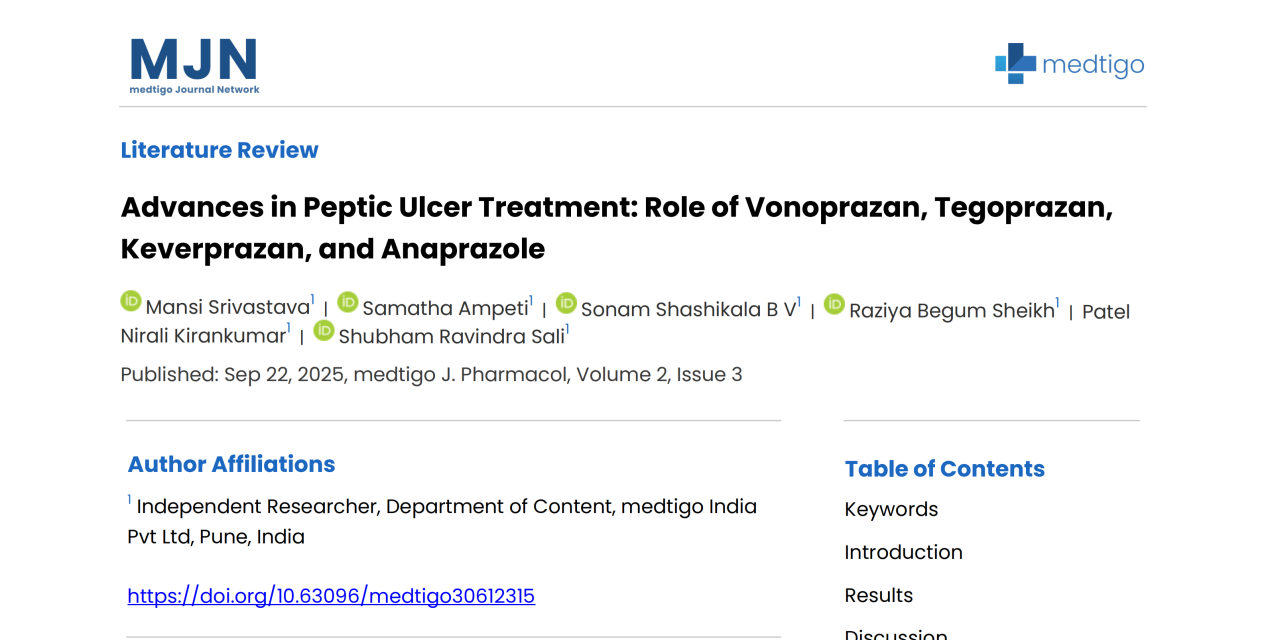
The international pharmaceutical journal MedTigo J. Pharmacol published a review article titled "Advances in Peptic Ulcer Treatment: The Role of Vonoprazan, Tegoprazan, Keverprazan, and Anaprazole." This review systematically evaluates the efficacy and safety of novel acid-suppressing agents worldwide. Notably, our company's independently developed innovative drug—anaprazole, as a representative of structurally modified new proton pump inhibitors (PPIs)—is listed alongside potassium ion competitive acid blockers (P-CABs) as a "new-generation" option that addresses the limitations of conventional treatments.
01. Breaking Tradition: Why is Anirazole highly anticipated?
The review highlights that to address the limitations of traditional proton pump inhibitors (PPIs), the development of novel acid-suppressing agents has primarily focused on two approaches: first, entirely new proton-capturing antibodies (P-CABs); second, structural optimization of PPIs. Ananilazole stands as an outstanding representative of the latter category. The article particularly emphasizes that ananilazole is a structurally modified proton pump inhibitor. Unlike conventional PPIs, ananilazole achieves a significant breakthrough in pharmacokinetics by incorporating a furan ring structure.
Unique metabolic pathway: exhibits characteristics of partial non-enzymatic metabolism.
Reducing metabolic dependence: Significantly decreases reliance on the CYP2C19 enzyme, thereby overcoming the issue of significant efficacy variability observed with conventional PIs across different genotypic populations.
02. Empirical data: Demonstrated efficacy with rapid onset of action
This review extensively cites Phase III clinical trial data on antrazole therapy for duodenal ulcers, conducting a head-to-head comparison with the classical drug rabeprazole. The results are encouraging and exhibit the following characteristics in addition to a high healing rate:
Rapid symptom relief: Data indicate that the majority of patients achieve pain relief within 2 days after receiving antrazole treatment. This "rapid onset" characteristic is particularly significant for ulcer patients requiring urgent improvement in quality of life.
High consistency of efficacy: Thanks to its unique metabolic mechanism, the review indicates that antrazole's therapeutic effect is not influenced by CYP2C19 gene polymorphisms or Helicobacter pylori (H. pylori) infection status, demonstrating excellent stability.
03. Safety evaluation: Good tolerability
Regarding safety, the review indicates that the overall safety profile of antrazole is comparable to that of rabeprazole. Adverse events primarily consisted of rare, mild abnormalities in liver or thyroid function, which were mostly transient; no unexpected severe adverse reactions were observed. This demonstrates that antrazole maintains favorable safety characteristics while providing highly effective acid suppression.
[Summary and Outlook]
The publication of this international review once again confirms the clinical value of antrazole in the treatment of peptic ulcers. As a novel proton pump inhibitor (PPI), antrazole not only inherits the well-established safety profile of PPIs but also addresses the core challenge of "metabolic stability" through structural innovation.
The article concludes: "Emerging therapies represented by antrazole provide more consistent acid suppression efficacy, faster symptom relief, and superior safety profiles, making them highly promising alternatives to traditional proton pump inhibitors (PPIs)." For clinicians, this means that in patients with complex metabolic backgrounds (e.g., CYP2C19 fast metabolizers), antrazole offers a preferred treatment option that requires no genetic testing, exhibits predictable efficacy, and demonstrates stability.
References :
Srivastava M, Srivastava M, et al. Advances in Peptic Ulcer Treatment- Role of Vonoprazan, Tegoprazan, Keverprazan, and Anaprazole. medtigo J. Pharmacol. 2025;2(3).
- Prev:Pilosidil tablets receive approval for first-line indication, becoming the first and only comprehensive treatment regimen for advanced HR+/HER2-negative breast cancer in China
- Next:A welcome breakthrough for patients with advanced breast cancer: the innovative drug piraroxil will be covered by medical insurance starting January 1, 2026.

9th Floor, North Tower of CP Center, No.20 Jin He East Avenue,Chaoyang District,Beijing,China
Tel:010-5765 4567
Email:XZGROUP@xuanzhubio.com
Copyright © 轩竹生物科技有限公司保留所有权利 冀ICP备2020028968号-2 网站建设技术支持:唯引互动
